Denver / Colorado
〰️
Denver / Colorado 〰️
Image: Boom Supersonic
The company building the world's fastest commercial airliner just found an unlikely way to pay for it.
Boom Supersonic has secured $300 million in new funding and announced a backlog worth more than $1.25 billion—and the thing financing the return of supersonic passenger travel is, unexpectedly, artificial intelligence.
The Denver-based aerospace company has developed Superpower, a 42-megawatt natural gas turbine built on the same engine core as its Symphony supersonic jet engine. AI data centres need enormous, reliable power—fast. Superpower delivers it, even in extreme heat, without the water dependency that makes many competing turbines impractical in arid locations. Crusoe, an energy-first AI infrastructure company, has placed the launch order: 29 Superpower units generating 1.21 gigawatts of capacity.
The revenue from that business directly funds certification and delivery of Overture, Boom's supersonic airliner.
"Supersonic technology is an accelerant—of course for faster flight, but now for artificial intelligence as well." Blake Scholl, Founder and CEO, Boom Supersonic
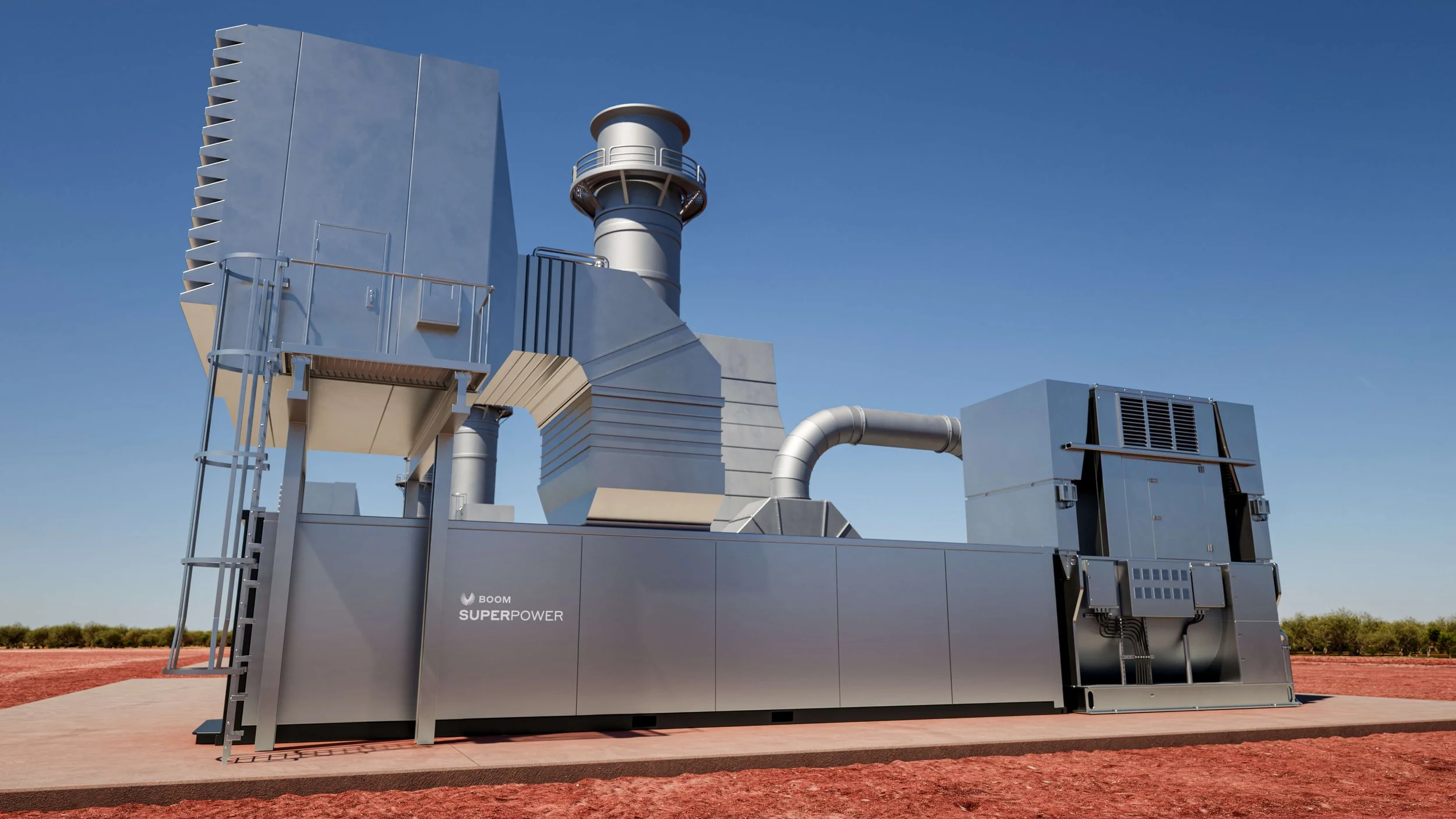
Image: Boom Supersonic
What Overture actually means for passengers
A transatlantic crossing from Newark to London would take around 3 hours 40 minutes. New York to Rome, four hours and forty minutes instead of eight. The kind of journey that currently requires a sleeping pill and a neck pillow becomes, on Overture, something closer to a long meeting.
Fares are expected to be comparable to today's business class, with an all-premium cabin and next-generation in-flight connectivity. Concorde, by comparison, cost the equivalent of roughly $21,000 return in today's money for the same New York-London route. Overture is targeting around $5,000.
Flying at 60,000 feet—high enough to see the curvature of the earth—Overture would also sit above most turbulence, making supersonic flight smoother than its subsonic equivalent.
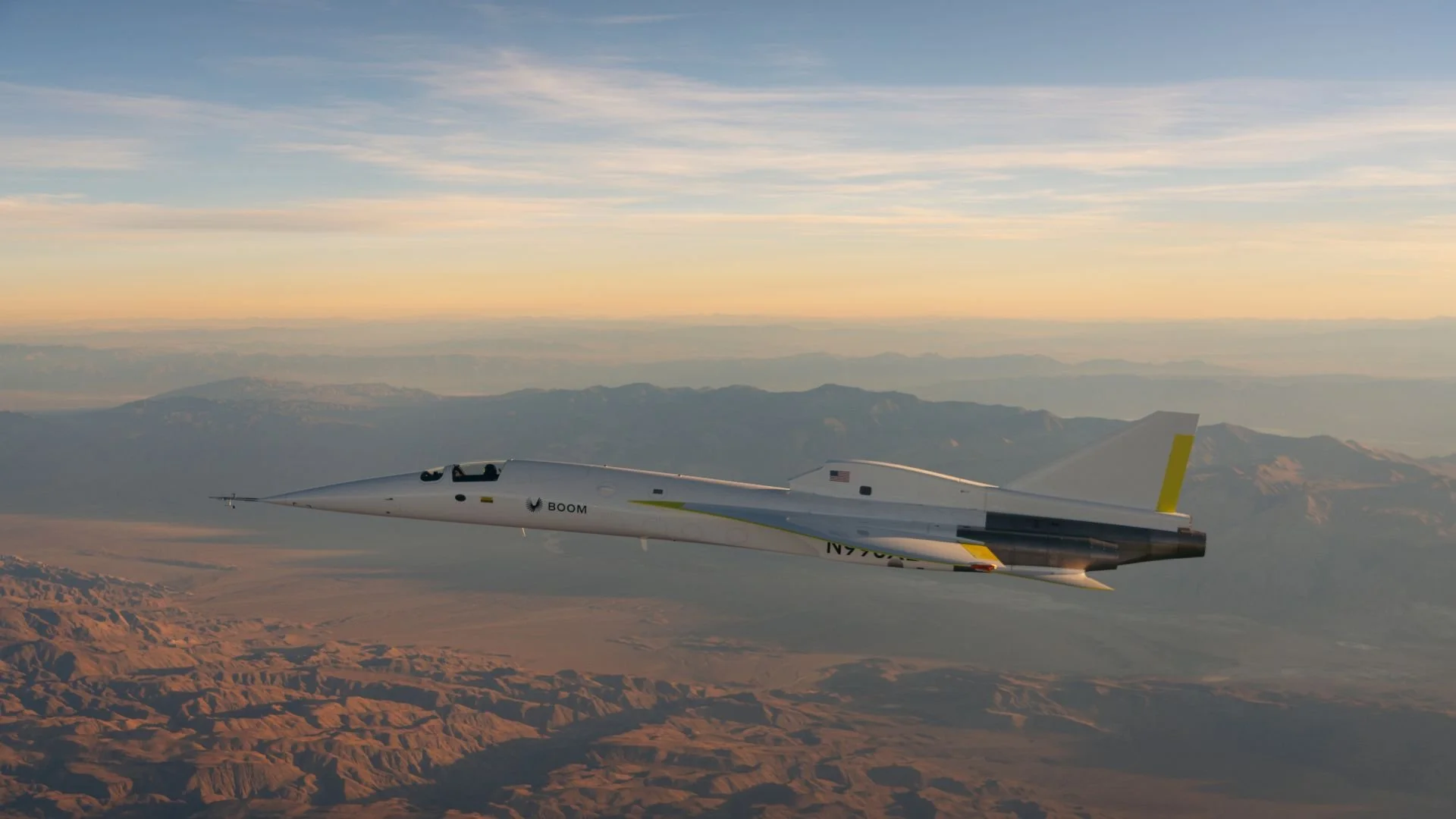
Image: Boom Supersonic
A smarter funding model than Concorde
The original supersonic era collapsed partly because it was never financially viable. Concorde served two routes, was banned from flying supersonically over land due to sonic boom concerns, and was subsidised by governments for most of its operational life.
Boom's approach is architecturally different. Rather than waiting for aviation revenue to fund aviation development, Superpower creates a parallel commercial engine—one that earns while Overture is still being certified. Overture is designed to run on 100% sustainable aviation fuel and features Boomless Cruise technology, which enables supersonic speeds without generating an audible sonic boom at ground level, significantly expanding the viable route network.
American Airlines has signed for 20 aircraft with options for 40 more. United Airlines holds a contract for 15 with options for 35. Japan Airlines has pre-orders for 20. Engine testing begins in 2026 at Boom's Colorado facility, with first flight targeted for 2028 and passenger service planned for 2029.
Image: Boom Supersonic
The bigger picture
There's a neat symmetry in the idea that the infrastructure powering AI's rapid growth is also funding the revival of an idea that felt, for two decades, permanently grounded. The Superpower turbine runs on natural gas, which positions it as a bridge technology rather than a final destination—cleaner than coal-fired alternatives, more reliable than renewables for always-on data centre loads, and purpose-built for conditions where conventional turbines lose capacity.
Whether Overture delivers on its promise is still an open question—supersonic aviation has a long history of ambitious timelines meeting difficult physics. But the funding model is credible in a way the Concorde era never managed, and the engine technology is, for the first time, being tested in the real world rather than on paper.
The world's fastest airliner might, it turns out, have AI to thank for getting off the ground.
