The future of search is a village

Shibuya Crossing, Tokyo.
For my sins, I was in a marketing meeting.
OpenAI had fired the starting gun of the generative AI race the prior spring releasing ChatGPT, and Google responded by rolling out Search Generative Experience, now "AI Overviews,” in a flat-footed scramble.
"The overlords are keeping us on our toes, again," sighed the search expert in the room.
Those of us who "make stuff for the internet," and report on the effectiveness of said “stuff,” with measures like traffic, click-through rate and conversion, were already knee-deep in a relentless deluge of well-intentioned concern trolling.
Said trolling broadly fell into the following lines of inquiry:
“Now that AI can make stuff for the internet, are you scared you won't have a job in the future?”
OK, coming in a little hot for a 9:15am stand-up.
and;
“What if Google stops sending traffic to the stuff you make for the internet, and you don't have a job in the present?”
*Checks watch* How is it only 9:17am?
I said I'd rather navigate the step change from traditional search engines to generative search than the step change from handing out pamphlets in the 1980s to digital marketing. However, since that meeting ended with the familiar whoosh-plonk of the Microsoft Teams "leave" button, which I have accepted I will likely be hearing until I slide off this mortal coil, I've been thinking about how I find stuff online, how others find what I put online, and how any of it will work in an increasingly volatile march of AI-enabled innovation, emergent platforms, and disruption.

If the author has 24 hours to live, get her to Galeries Lafayette Haussmann.
The story of finding stuff.
In ye olde times (like, 10,000BCE) humans figured out how to domesticate plants and animals.
That meant we could ditch our nomadic lifestyles, settle down in one place together, and build societies—until chic co-working spaces with good WiFi led to a digital nomadic renaissance around... *checks watch* now.
As societies developed, humans started making stuff. And we loved it.
We made big existential stuff like governments and culture and religion, and we made small practical stuff like bowls, shoes and (later) air fryers.
If I made great bowls and you made great shoes, we might trade. When people saw your new shoes, or got served dinner from my new bowls, we'd refer foot traffic to each other through word of mouth.
Once we really hit our stride with making stuff and telling each other about it, we invented "shops" and "market stalls" to stock all the stuff, and "money," so that people who didn't make stuff could buy things.
Eventually when there was enough stuff, shops and money, we calmly and responsibly decided we had enough and all went back to farming.
Psych! We doubled the heck down.
We connected all the shops up and made bigger ones called "malls." We smooshed all the market stalls together and made "supermarkets," which were just like regular markets, but super.
Eventually word of mouth just couldn't keep up with the scale of all the stuff and places to buy it. So we invented "marketing," and made ways to tell people about stuff at scale through logos, slogans, events, billboards, commercials, pamphlets, partnerships, and sometimes even literal airplanes that wrote words on the actual sky.
Then in 1989 a guy called Tim tabled the concept of a "web of information" on a network of computers, and the World (Wide Web) cracked open.
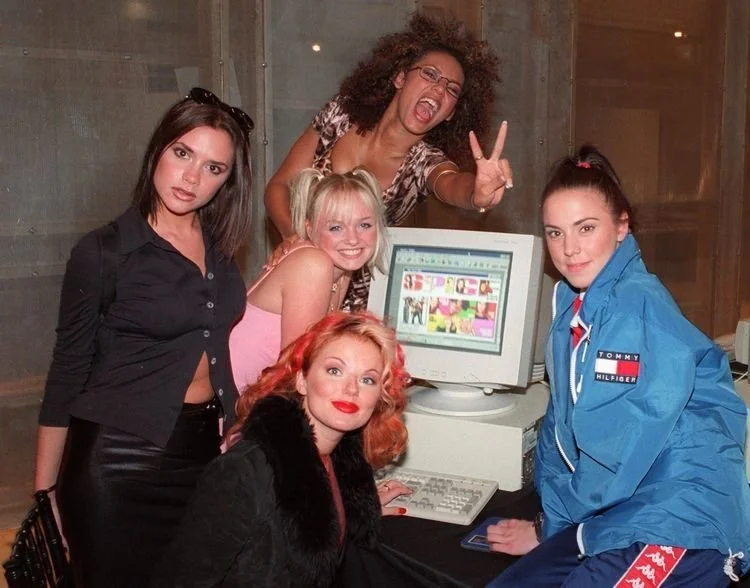
The Spice Girls at AOL in May, 1997 for a live web chat with fans.
The story of finding stuff online.
In ye recent times (like, 1991) humans figured out how to domesticate the internet. That meant our insatiable, and now refined, love of making stuff could extend into exotic new places online called "websites."
If I made a website called www.shoes.com and you made one called www.bowls.com, people had to know our specific URLs to find us, which was really quite annoying because we'd just learned where all the shops were in the physical world we'd built.
Enter the search engine.
Early search engines like Archie and Yahoo took all the URLs like shoes.com and bowls.com and listed them in one spot, referring digital foot traffic to each site a bit like the index page of a book or shopping mall directory.
Eventually two guys called Larry and Sergey from Stanford created a new type of search engine that indexed all the websites for shoes, bowls and (later) air fryers, and built an algorithm that would refer traffic to each site based on, among other things, how many times it had been linked to.
They whipped up a splash screen with some colourful text, added a search box and, voilà, the world's most powerful search engine was born. And we loved Google. We loved it so much we even made their brand name a verb!
It was easy to find stuff. They had a Fun Logo. They told us they weren't going to "be evil," and it was the 90s (the first time, not Gen Z revival 90s), so most regular shoe-and-bowl folk like us hadn't thought about things like data privacy yet.
But when you create the search engine—and the legitimate avenues shoes.com and bowls.com use to show up on the first page of it—the dark matter left behind is how the system gets gamed. Google created the environment of keyword optimisation, and we capitalised on it. Or as the late Charlie Munger would say: "show me the incentive, and I'll show you the outcome."
The search engine worked. Then it got gamed. Then it got worse.
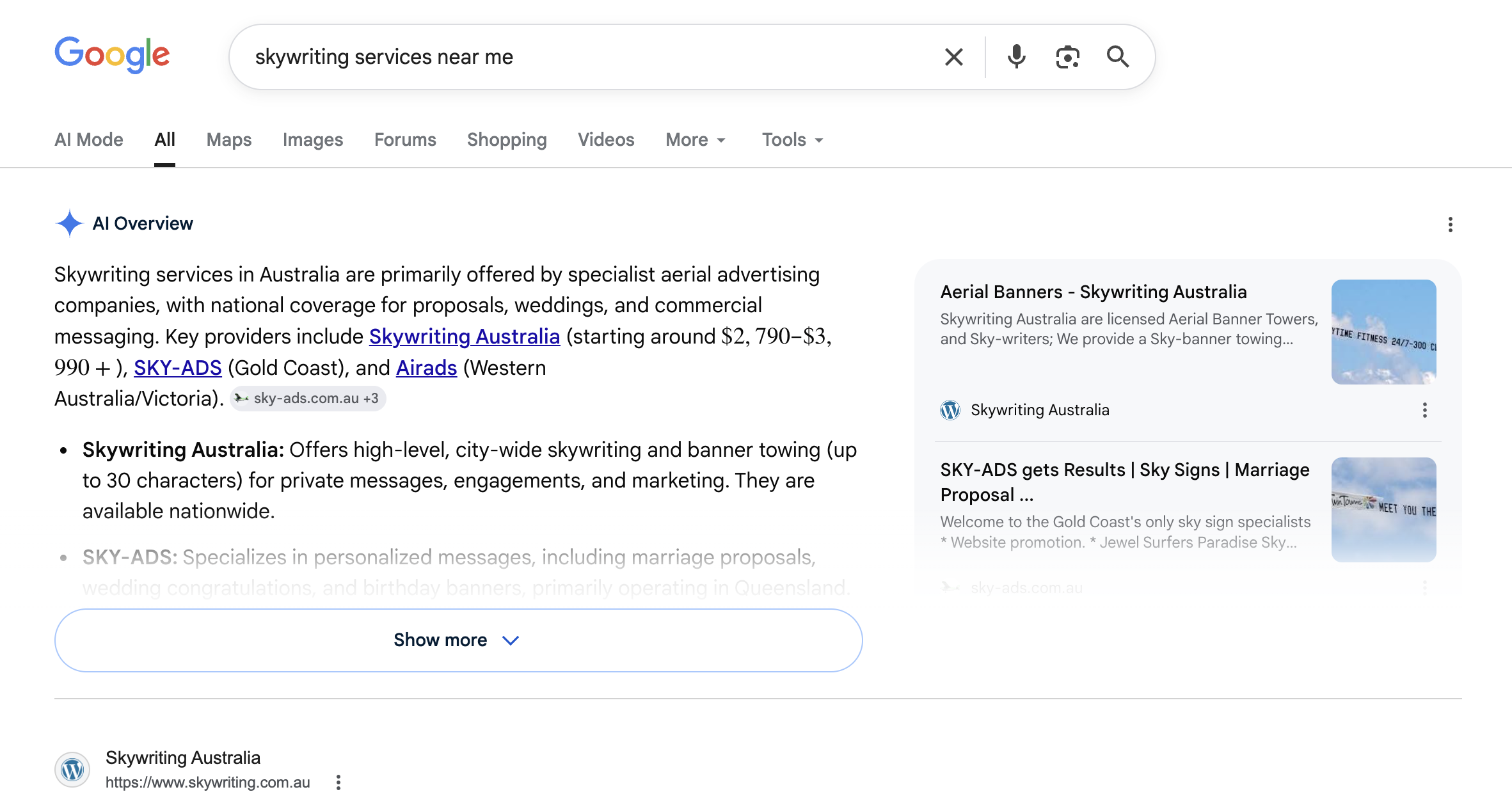
Artist: Unkown.
The erosion of search.
I don't know exactly when I stopped finding "the world's information" on Google "universally accessible and useful."
It was as John Green wrote in The Fault in Our Stars, "slowly, and then all at once."
Somewhere between an increasing barrage of sponsored blue links and spammy written content, how I found the world's information began to change. Platforms like Instagram and TikTok surfaced short form videos effortlessly before my eyes, like the ever-changing view from a forward facing seat on a train. Reddit had a better community, different perspectives, and less filter. Newsletters materialised in my inbox with impeccable timing (Tuesdays at 10am, anyone?), their salutation logic greeting me warmly: "Hi <First name>."Google's search relevance became, well, less relevant. The blue underlined links weren't so trustworthy anymore. The cooking recipes were overwritten with personal anecdotes (no one, save for the algorithm, cares about the quaint Airbnb you stayed at when you first baked those "easy choc chip cookies.")
The numbers were already stark before AI Overviews arrived. Sixty percent of Google searches were ending without any click to a website—a phenomenon analysts call "The Great Decoupling" (distinct from, though spiritually adjacent to, Gwyneth Paltrow and Chris Martin's 2014 "conscious uncoupling") where search engine usage keeps rising while clicks to websites decline. Rather like how an economy can post record growth while most people's paycheques stay the same. Not that there are any recent examples of that.
Then came AI Overviews: Google's attempt to answer your question before you'd finished asking it. The acceleration was immediate.Google search traffic to publishers dropped globally by a third in the year to November 2025, according to Chartbeat data. The Verge, a publication that has spent years thinking harder than most about what a sustainable digital media business actually looks like, describes it plainly. Helen Havlak, The Verge's publisher, said the extinction level event is already here, and a number of small publishers have already gone out of business.
Meanwhile, traffic from all AI native channels combined, ChatGPT, Perplexity, Gemini, accounts for just 1% of all publisher traffic. The promise that AI search would simply redirect the traffic somewhere new has not materialised.
Traffic hasn’t disappeared, not exactly. Think of it like liquidity in a credit crunch: the money is still there, it’s just stopped moving. Attention has pooled inside platforms that were specifically designed to keep it. Instagram doesn’t want you opening a browser tab. TikTok doesn’t want you leaving TikTok. The open web didn’t lose to a vacuum. It lost to walled gardens that got very good at being stickier than a search result.The traffic is not being redirected.
It’s just gone—from you.
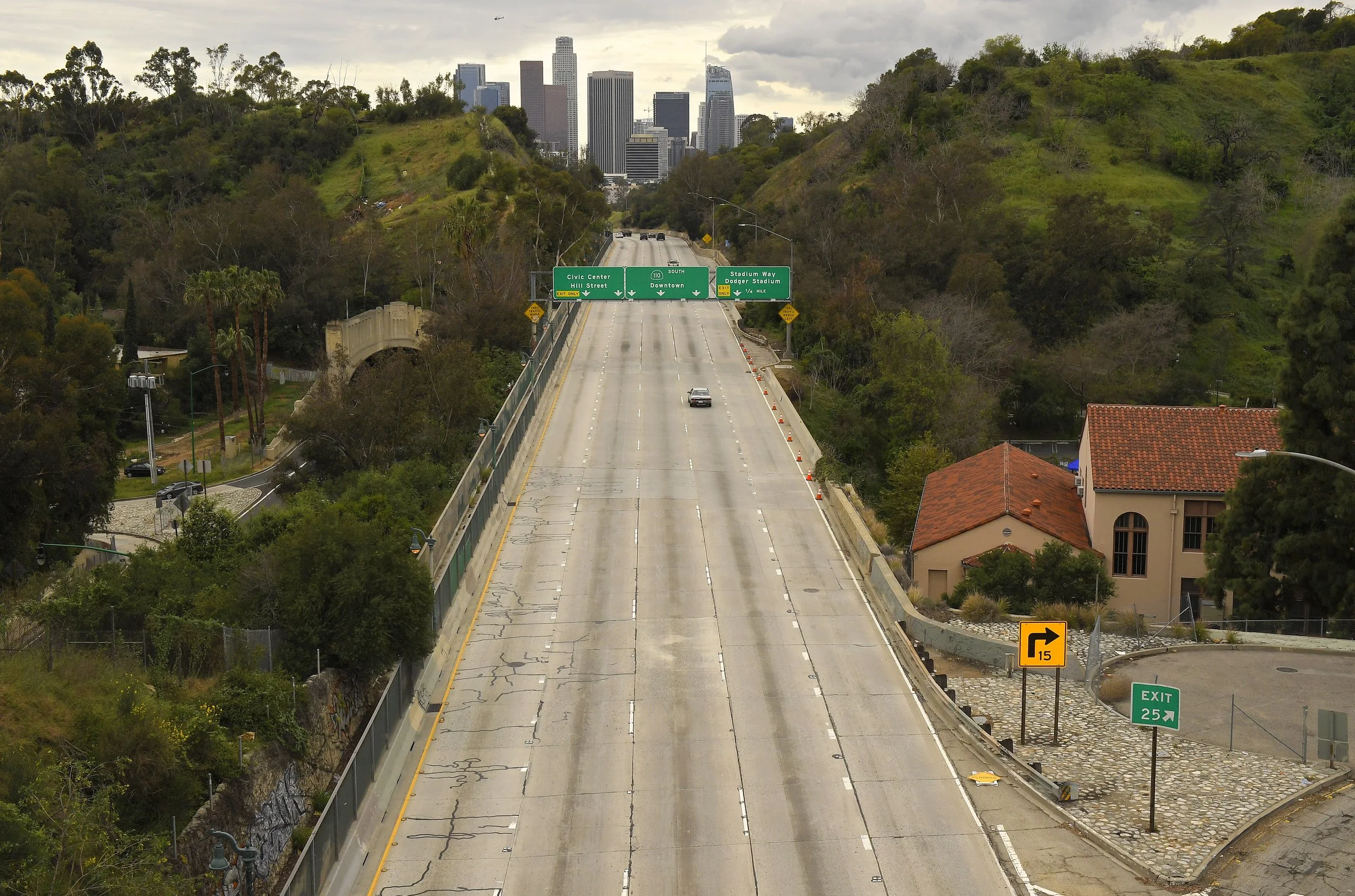
Photographer: Robert Gauthier/Los Angeles Times
So where to from here?
Think about how you actually find things. Not how you're supposed to find things, or how your marketing strategy said your customers would find things. Think about how you actually do it.
Maybe you caught something on TikTok. A friend sent you a link in a group chat. You remembered a newsletter you'd saved last Tuesday at 10am. A Reddit thread had twenty responses from people, and a handful of bots, who'd actually tried the thing. A podcast mentioned it in passing three weeks ago. Didn’t you see it on a train the other week? Wait, no, wasn’t it a billboard? You Googled it anyway out of sheer muscle memory (what’s next, a Rolodex?) and got an AI summary that was a coin toss of right, or “confidently wrong.”
That's not a search funnel. That's a village of touchpoints. It might be what your marketers have been calling an omni or multichannel marketing approach since 2010 (weary marketers, I see you.)
Facebook referral traffic is down 50% since 2023. Publishers have largely given up on Facebook and X as meaningful traffic sources. But consumers' attention went somewhere. Podcasts crossed 580 million global listeners in 2025. Nine in ten Americans subscribe to at least one newsletter.It's happened before. When the Visigoths made mainland life untenable in the 5th century, the communities of the Veneto relocated to a cluster of muddy islands in a lagoon. Same people, same trade networks, same instinct to make and sell things. They built Venice.
The question that the search expert in the room that day in 2023 was asking wasn’t really "will AI replace my job?" (Though swathes of stock-bump tech layoffs suggest that one isn’t entirely without merit.)It was:What happens when the single road into town gets closed, and we built our whole trade assuming it would stay open?
Google was the road. Most of the internet—publishers, shops, digital products, bowls.com, shoes.com—built their entire model on it. And now publishers forecast search engine traffic down 43% within three years, with a fifth expecting losses above 75%.
The publishers, brands and creators who have fared best diversified before they had to. Some of the most resilient ones look less like media companies or products, and more like communities: brands building owned audiences through newsletters and podcasts, companies like Gymshark and Liquid Death behaving more like cultural participants than advertisers, and artists turning group chats into distribution engines like Fred Again.
Yes, that means experimenting with emergent, generative search channels. It means email lists and podcasts. TikTok, LinkedIn, an exclusive dinner, a conference stage, a room. A literal plane writing on the actual sky. Coverage in a masthead that means something to the people you're trying to reach. The kind of presence that doesn't vanish when an algorithm updates at 3am.
If Google stopped sending you traffic tomorrow, what would you have left?
The honest answer is your actual business. The people who'd come looking for you even if Google stopped pointing the way. Everything else was rented traffic. (Any marketing strategy that refers to a Meta platform as an “owned channel,” can see itself out. Mark owns those channels.)
It's a village. A big old omni-channel village.
*Gestures everywhere.*
It’s word of mouth. Trust. Reputation. Community. The same economy that moved shoes and bowls around a market in 10,000BCE, just expressed across more surfaces than they could have imagined, and occasionally summarised by a chatbot. Hallucinations and all.
It's going to be a more interesting time to make things. Interesting in the full, uncomfortable sense of the word, and certainly not the frictionless AI utopia being sold to us by a small collection of highly incentivised Silicon Valley types. "Show me the incentive, and I'll show you the outcome," echoes Munger.
A more interesting time to find things, and to be found by each other. The technology that was supposed to flatten everything into the mythical "dollar in, two dollars out" creativity machine may instead push us toward something more textured. Toward the places where it meets real life, real people, real word of mouth.
It’s a village.

Venice from above. Image: Wikipedia.
